


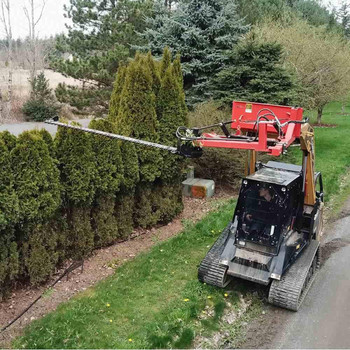
Sickle Bar Mowers: Old-School Technology, New Opportunities for Skid Steer Owners
Posted by Nate Hagen on 15th Oct 2026
Sickle Bar Mowers: Old-School Technology, New Opportunities for Skid Steer Owners
Sometimes the best solution isn't the newest technology on the market. Sometimes it's an old idea that still solves problems modern equipment struggles with.
Take the sickle bar mower.
If you've spent any time around farming equipment, you've probably seen one. The technology has been around for generations, cutting everything from hay fields to roadside vegetation.
But here's something worth thinking about: What happens when you take that same cutting technology and put it on a modern skid steer, mini skid steer, or excavator?
You end up with an attachment that can tackle jobs many traditional brush cutters simply aren't designed to handle.
Roadside maintenance, ditch banks, pond edges, fence lines, and even overhead hedge trimming are all applications where a sickle bar mower deserves a closer look.
So, are sickle mowers an overlooked opportunity for today's equipment owners? Let's break it down.
How Does a Sickle Bar Mower Actually Work?
Unlike a traditional rotary brush cutter that uses spinning blades to chop vegetation, a sickle bar mower uses a reciprocating cutting action.
Think of a long pair of scissors.
A series of sharp cutting sections moves back and forth against stationary guards, shearing vegetation as it passes through the cutter bar.
It's a simple concept, but that cutting action creates some important advantages.
First, you're cutting vegetation rather than repeatedly striking and shredding it. Second, the cutter bar can be positioned vertically, horizontally, or at an angle, depending on the attachment.
Perhaps most importantly, a sickle bar generally produces far less flying debris than an open rotary cutter.
That doesn't make it risk-free, but for contractors maintaining vegetation near roads, buildings, fences, or other sensitive areas, it's a meaningful difference.
Where Sickle Bar Mowers Really Shine
1. Roadside Mowing and Ditch Maintenance
Imagine you're maintaining a long stretch of roadside where grass and brush have grown down an embankment.
A conventional skid steer mower can cut the flat ground, but what happens when the vegetation extends several feet below the road?
Driving the machine down the embankment might be unsafe or impractical. Reaching it with handheld equipment could mean additional labor and considerable time.
This is where an offset sickle bar mower earns its keep.
Depending on the mounting system, an operator can position the cutter bar over a ditch or along a slope while keeping the machine on suitable, stable ground.
For contractors handling miles of roadside maintenance, that reach can be far more valuable than simply having a wider mower.
2. Hedge Trimming and Property Maintenance
Most people associate skid steer attachments with moving dirt, cutting trees, or clearing brush.
But what about maintaining overgrown hedges?
A sickle bar mower can be especially useful for trimming long hedge lines, shaping vegetation, and cutting branches within its rated capacity, Generally around 1 - 2" brush for most sickles.
Because many models offer adjustable cutting angles, an operator can work along the sides or tops of vegetation without constantly repositioning the machine.
For commercial landscapers, property maintenance contractors, and municipalities, that versatility creates opportunities beyond traditional mowing.
3. Pond Banks and Waterways
Maintaining vegetation around water is another challenge.
Soft ground, steep banks, and limited machine access can turn a seemingly simple mowing job into a difficult project.
A properly configured boom-mounted or excavator-mounted sickle mower can extend into these areas while the machine operates from a suitable location.
Certain sickle mower models are also specifically approved for aquatic vegetation cutting.
Here’s an important distinction: Not all sickle bar mowers can be fully submerged. For example, Eterra offers a 5-foot sickle mower that is fully submersible, including the hydraulic motor. However, on the 7-foot and 9-foot models, the cutting blades can be submerged, but the hydraulic motor must remain above water.
Work around waterways may also require additional permits and environmental precautions.
Sickle Bar vs. Flail Mower vs. Rotary Cutter: Which Is Better?
This is where things get interesting.
At Skid Steer Solutions, we believe the best attachment isn't necessarily the biggest, most expensive, or most aggressive.
It's the one that solves the problem you're actually dealing with.
|
Attachment
|
Where it excels
|
Where it struggles
|
|---|---|---|
|
Sickle Bar Mower
|
Roadsides, hedge trimming, ditches, controlled cutting and hard-to-reach vegetation
|
Mulching, grinding, and processing heavy material
|
|
Flail Mower
|
Grass, brush, overgrowth, and producing a finer finished result
|
Precision hedge shaping and extreme side reach without a boom
|
|
Rotary Brush Cutter
|
Heavy brush, larger vegetation, and aggressive clearing
|
Greater projectile risk and less precise cutting around obstacles
|
When We'd Choose a Sickle
If the job involves reaching over an embankment, trimming a hedge, or cutting vegetation near an area where debris is a concern, a sickle mower would be high on the list.
When We'd Choose a Flail
If the goal is knocking down grass and brush while leaving a more processed finish, a flail mower is often a better choice.
When We'd Choose a Rotary Cutter
If we're clearing a neglected property full of heavier brush and saplings, a properly sized rotary cutter may be the most productive option.
The takeaway? A sickle bar mower isn't necessarily replacing your brush cutter. It's giving your machine another capability.
And for the right contractor, that capability could be an entirely new service to offer customers.
What Are the Best Sickle Bar Mower Options for Skid Steers?
Instead of declaring one attachment the best for everyone, we'd start with the type of machine and the work you're planning to perform.
One manufacturer worth looking at is Eterra Attachments, which offers several configurations built around different carriers and applications.
Standard Skid Steer Sickle Bar Mower
Eterra offers dedicated skid steer sickle mowers with 7-foot and 9-foot cutting bars.
These are designed for roadside vegetation, overgrowth, hedge maintenance, and other jobs where adjustable cutting angles are useful.
They're worth considering if you want a dedicated side-cutting attachment without purchasing an entire separate boom system.
Boom-Mounted Sickle Mower
For operators who need additional reach, a sickle mower mounted on a boom arm changes the equation.
Eterra's Raptor Boom Arm system can be configured with 5-foot, 7-foot, or 9-foot sickle mower heads.
This allows the operator to position the cutter farther away from the machine for roadside trimming, ditches, embankments, and overhead vegetation.
The 5-foot Raptor sickle head is also aquatic-approved, unlike its longer 7-foot and 9-foot versions.
One thing to watch when shopping: some listings are for the sickle mower head only, not the complete boom arm system, It's always a good idea to reach out to an expert to discuss your specific application and make sure you're choosing the right attachment for the job.
Mini Skid Steer Sickle Mower
Don't overlook the smaller machines.
Mini skid steers can be excellent tools for working around homes, narrow access points, landscape beds, and areas where larger equipment simply won't fit.
Eterra also offers a 5-foot sickle mower designed for mini skid steers.
For a landscaping business already operating a mini skid steer, a sickle mower may open up specialized trimming jobs without requiring another carrier machine.
Excavator-Mounted Sickle Mower
Have a compact excavator sitting between
digging jobs?
Depending on the machine, an excavator-mounted sickle could be worth considering.
The excavator's boom and stick provide positioning options that can be useful for reaching over obstacles, trimming slopes, and managing vegetation along waterways.
Of course, machine stability, hydraulic compatibility, and the approved working envelope still determine what can safely be done.
Five Things to Check Before Buying a Sickle Bar Mower
Before you purchase any sickle mower attachment, there are a few questions worth answering.
-
What material are you cutting? Tall grass, flexible brush, and hedge growth are different from dense trees and heavy woody material. Don't confuse maximum cutting diameter with the ability to clear an entire stand of heavy brush efficiently.
-
How much reach do you need? A direct-mounted mower might be perfect for roadside trimming, while a boom-mounted system could be more practical for steep ditch banks or overhead work.
-
What are your machine's hydraulic specifications? Verify auxiliary flow, pressure, couplers, attachment controls, and motor configuration. A mower that doesn't match the machine won't deliver the performance you expect.
-
How easy is it to service? Cutting sections and guards are wear items. Check replacement parts availability, cutter-bar adjustment requirements, lubrication points, and service access.
-
How often will you use it? For a contractor doing occasional property cleanup, another style of mower might be more versatile. For someone regularly maintaining roadside vegetation, the right sickle mower could be a valuable addition to the fleet.
And regardless of which mower you're operating, always follow the manufacturer's operating instructions, exclusion zones, traffic-control requirements, and machine stability limits.
Can a Sickle Mower Actually Help Grow Your Business?
Here's where equipment ownership gets interesting.
A lot of contractors think about growing their business by purchasing another machine or hiring another employee.
But sometimes growth comes from expanding the types of jobs you can take on with equipment you already own.
Let's say you're a landscaping contractor with a skid steer.
Today, you handle mowing, brush cutting, grading, and general property maintenance.
Now imagine adding specialized roadside trimming, HOA hedge maintenance, or seasonal drainage-ditch vegetation control.
Suddenly you're offering customers services that not every contractor in your area is equipped to handle.
That doesn't automatically mean a sickle mower will pay for itself. You still need enough demand, profitable pricing, and a machine that fits the job.
But it does raise an important question:
Could adding the right attachment create more revenue opportunities than simply buying another machine?
For some businesses, the answer may be yes.
Frequently Asked Questions
Can a skid steer sickle mower cut small trees?
Some heavy-duty models are rated for woody material up to 2 inches in diameter. Actual performance depends on the material, cutter design, and operating conditions. They aren't substitutes for forestry mulchers or heavy-duty tree-clearing equipment.
Are sickle bar mowers safer than rotary cutters?
They generally have a lower tendency to launch debris because they shear material rather than using high-speed rotating blades. However, serious cutting, crushing, and impact hazards remain. Operators must follow all safety procedures and keep people clear of the work area.
Are sickle mowers good for cutting grass?
Yes, particularly tall grass and vegetation along slopes, roadsides, and fence lines. However, they generally leave cut vegetation behind rather than finely mulching it like many rotary or flail mowers.
Final Thoughts: Don't Overlook the Simple Tools
The sickle bar mower might not be the flashiest attachment on the market.
It doesn't have the intimidating appearance of a forestry mulcher or the aggressive cutting action of a heavy-duty rotary mower.
But not every job calls for brute force.
Sometimes you need reach. Sometimes you need precision. Sometimes you need to cut vegetation without scattering debris across a customer's property.
And sometimes an attachment based on technology that's been around for generations is still the right answer.
At Skid Steer Solutions, we're big believers in finding the right tool for the job—not just selling someone another attachment.
If you're considering a sickle mower, take a look at our skid steer sickle bar mower options, or give us a call at 866-966-2538.
Tell us what machine you're running and what you're trying to accomplish. We'll help you figure out whether a sickle mower, flail mower, or rotary cutter makes the most sense.
More Than Attachments. Real Solutions.